

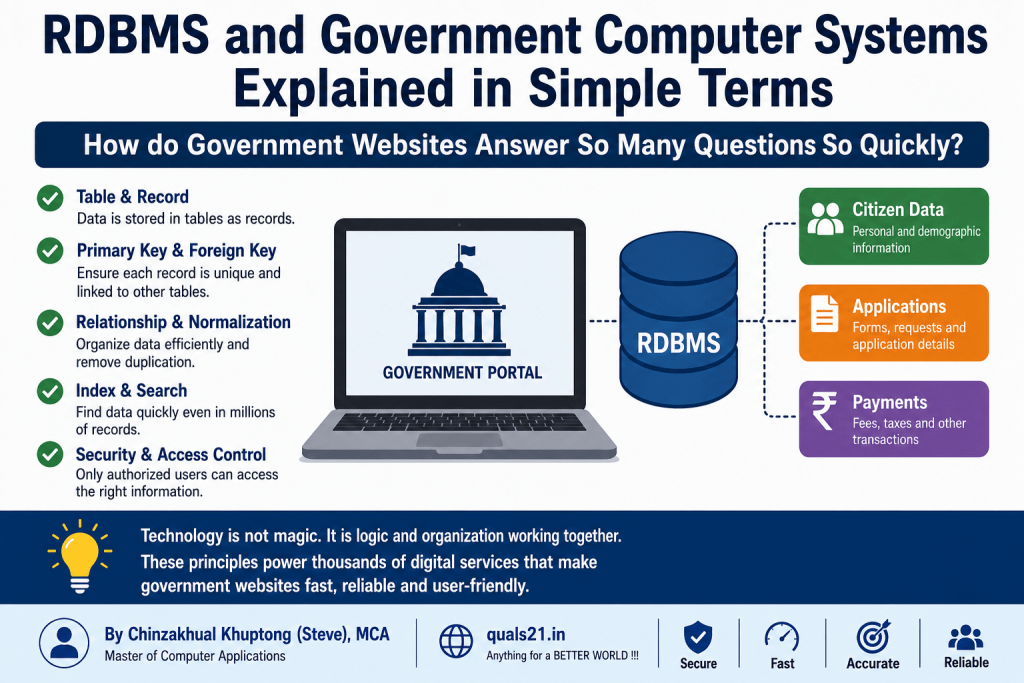
Why Government Websites Ask So Many Questions: Understanding RDBMS Through Everyday Government Services
A Simple Guide for Citizens, Government Employees, Students and Professionals
By Chinzakhual Khuptong (Steve), MCA
Introduction
Whether we realize it or not, most of us interact with a government database almost every day.
We update our Aadhaar details, check voter information, apply for scholarships, register for government jobs, receive pensions, use digital health services, pay taxes, link bank accounts, or download certificates. To us, these activities appear simple—we fill in an online form, click Submit, and within a few seconds the website responds.
Sometimes it displays “Application Submitted Successfully.”
Sometimes it says “Record Already Exists.”
Sometimes it reports “Details Do Not Match.”
Many people assume that these websites simply store information. In reality, they perform many complex tasks behind the scenes—validating data, searching millions of records, checking relationships between information, preventing duplicate entries, retrieving previous records, and displaying only the information the user is authorized to see.
Behind most of these systems is a technology called the Relational Database Management System (RDBMS).
In an earlier article, I explained what a Database Management System (DBMS) is. In this article, we take the next step by understanding what makes an RDBMS different and why it has become the backbone of modern digital government.
Imagine a Government Office Before Computers
Before computers became common, government offices depended almost entirely on paper files.
Imagine entering a district office thirty years ago. Steel cupboards filled every room. Thousands of paper files were arranged on shelves. If an officer wanted to locate one citizen’s record, someone had to search through folders manually. Updating one address might require changing several files in different departments. Duplicate records and missing files were common.
Computers changed this process completely.
Instead of storing information in paper files, they store it in carefully organized electronic structures called tables.
What Is a Table?
The word table sounds technical, but the idea is simple.
If you have ever used Microsoft Excel or even written information in a notebook with rows and columns, you have already used something very similar.
A database table is simply an organized collection of similar information.
| Citizen ID | Name | Date of Birth | District |
|---|---|---|---|
| 1001 | Rahul Kumar | 12-05-1998 | Delhi |
| 1002 | Sita Devi | 03-09-1996 | Jaipur |
| 1003 | Amit Singh | 25-11-2000 | Bhopal |
Each row represents one citizen. Database professionals call each row a record.
Each column stores one type of information, called a field.
Instead of maintaining thousands of paper files, the computer stores millions of such records electronically.
How You Experience This as a CitizenWhen you submit an online application, the system usually creates a new record inside the appropriate table. Your application becomes one row among millions of other rows.
Why Every Table Needs a Primary Key
Now imagine that there are hundreds of citizens named Rahul Kumar.
If a government officer searches only by name, which Rahul Kumar should the computer choose?
The computer therefore needs one value that identifies exactly one record.
This unique identifier is called the Primary Key.
Think of it as the house number of a building. Many people may live on the same street, but every house has a unique number.
Similarly, every record in a table must have one unique identity.
The important rule is simple:
No two records can have the same Primary Key.
How You Experience This as a CitizenWhen you enter an application number to check your status, the system uses that unique identifier to locate your exact record.
Why Does the Database Need More Than One Table?
Suppose one citizen has:
- a bank account,
- a scholarship application,
- a pension record,
- a land record,
- a driving licence,
- and several tax payments.
Should all of this information be stored in one giant table?
No.
Different types of information belong in different tables because each serves a different purpose. This makes the system easier to maintain, faster to search, and less prone to errors.
What Is a Foreign Key?
If citizen information is stored in one table and bank accounts in another, how does the computer know which bank account belongs to which citizen?
The answer is the Foreign Key.
A foreign key is simply a value that refers to a related record in another table.
Think of it as writing a file number on another document instead of photocopying the entire file.
Instead of copying the citizen’s complete details into every table, the system stores a reference.
This reference creates a logical relationship between different tables.
How You Experience This as a CitizenWhen a government portal displays your profile together with your application history or payment status, it is often retrieving related information from several tables using these relationships.
What Does “Relational” Mean?
The word Relational simply means that different tables are logically connected.
Think about a family.
A father, mother, and children each have their own identities, yet they are related.
Likewise, a citizen table, a payment table, and an application table remain separate but are connected through carefully defined relationships.
This organization keeps information accurate and avoids unnecessary duplication.
Important: Different government departments usually maintain separate databases and their own internal identifiers. Where information is shared, it typically happens through authorized verification services or approved data exchanges—not through one giant national database.
What Is Normalization?
Imagine writing your home address in ten different notebooks.
When you move to another city, you must update all ten copies.
If one copy is forgotten, conflicting information appears.
Normalization is the process of organizing data to reduce unnecessary duplication.
Instead of storing the same information repeatedly, a well-designed database stores it once where appropriate and allows related tables to refer to it.
Normalization offers several advantages:
- Less duplicate information
- Smaller storage requirements
- Easier updates
- Fewer mistakes
- Better consistency
How You Experience This as a CitizenIf one department updates your address, another department may still show the old address because each maintains its own database. Information sharing between departments follows authorized processes and is not always automatic.
What Happens After You Click “Submit”?
Many people believe that clicking Submit simply saves the form.
In reality, the system may:
- Check mandatory fields.
- Validate dates and identification numbers.
- Look for duplicate records.
- Verify related information where required.
- Store the new record.
- Retrieve updated information.
- Display a confirmation message.
All of this usually happens within a few seconds.
Why Are Government Websites So Fast?
Searching millions of records one by one would be far too slow.
Instead, databases use indexes, which work much like the index of a book. Rather than reading every page, the database follows organized lookup structures that point directly to the required information.
Why Can Different Officers See Different Information?
Not every government employee should have access to every detail.
Databases use views, permissions, and role-based access control so that each officer sees only the information needed for their work.
This improves both privacy and security.
Conclusion
The true strength of an RDBMS is not simply storing information. Its real power lies in organizing data, maintaining logical relationships, preventing duplication, validating entries, retrieving records quickly, and supporting secure access for millions of users.
Every online application, certificate download, pension payment, scholarship approval, or status enquiry depends on these principles.
Once we understand concepts such as tables, records, primary keys, foreign keys, relationships, normalization, and indexes, government websites become much easier to understand.
Technology is not magic. It is organized logic working quietly behind every digital service we use.
About the Author
Chinzakhual Khuptong (Steve), MCA
The author writes about information technology, digital governance, artificial intelligence, cloud computing, and cybersecurity in simple language. His aim is to bridge the gap between complex technology and everyday understanding so that students, government employees, professionals, and ordinary citizens can confidently understand the digital systems they use every day.
>Bangziak a Government Website-te’n Question tampi hon dong uh hiam?
RDBMS leh Government Computer System-te Paite pau in Baihlam tak a Theihna
By Chinzakhual Khuptong (Steve), MCA
Thumapi
Tunin mi tam zaw in Government website leh online service-te i zang chiat ua.
- Aadhaar update i bawl
- Voter ID i check
- Scholarship i apply
- Government job i apply
- Bank account i link
- Land record i en
- Certificate i download
- Tax i pai a ,leh adang dang tampi
I bawl ua, ei muhdan ah bangmah haksa omlou ahi.
Form khat i fill-up ua, Submit i click ua, huchih leh second tawmchik sungin computer in reply hon bawl pah hi.
Khatvei lah Application Submitted Successfully aki chi a.
Khatvei lah Record Already Exists aki chi a.
Khatvei lah Details Do Not Match aki chi hi.
Bangziak a hichia hih theih hiam?
Mi tamtak in Government website-te pen “data khawlna” chauh ahi chi in ngaihsun uh.
Himahleh hua sangin naa nasatak in sem zaw hi.
Computer in:
- Data a check
- Search a bawl
- Duplicate a en
- Record khat leh record dang kizopna a zong
- Information a lakhawm
- Mi khen khat chauh muh phal ding a di chauh a lakhia hi.
Hiai teng khempeuh pen Relational Database Management System (RDBMS) kichi technology khat tungah kinga ahi.
Article masa ah DBMS bang ahihna ka genkhinta a.
Tunin hiai article ah DBMS leh RDBMS kibat louhna leh bangziak a Government Computer System tampii in RDBMS zang uh hiam chih en ding i hi.
Computer om ma a Government Office-te
Computer om masang in Government Office tampi in paper file chauh kizang hi.
Office sung lut lechin steel cupboard tampi na mu ding.
File sang tampi.
Citizen Record tampi.
Officer khat in mi khat Record zong ding leh file tampi sung zong ngai ding.
Address khat kikheng leh Department dang dang ah file tampi bawlthak ngai.
A kibang Record tampi om thei.
File mang thei.
Thil tampi ki hih khial thei.
Computer hong om pat chiangin hiai buaina tampi a kiam ta hi.
Paper file munah Computer in Table kichi electronic file zangta.
Table bang ahi hiam?
“Table” chih thumal pen haksa bangin kilang mahleh a baih lam mahmah.
Microsoft Excel na zang ngei leh notebook ah row leh column tawh data na gelh ngei leh Table bang hiam na thei khinta ding hi.
Table pen data kibangte khawlkhawmna mun ahi.
Etsakna ding in:
| Citizen ID | Min | Pianni | District |
|---|---|---|---|
| 1001 | Rahul | 1998 | Delhi |
Row khat pen Record khat ahi.
Column khat pen Field khat ahi.
Government Database khat sung ah hichibang Record million tampi om thei hi.
Na MuhdanScholarship na apply chiangin nangma application pen Table sung ah Record thak khat hong suakta hi.
Bangziak in Primary Key kisam hiam?
Ngaihsun in.
District khat sung ah Rahul Kumar min nei mi 500 om leh bangchi in Computer in nangmah Rahul Kumar pen hong zong khe thei ding hiam?
Min chauh tawh zong hileh hih khial thei.
Huaiziak in Record khat khat in identity kibanglo neih kul hi.
Hiai pen Primary Key kici hi.
Inn number tawh kibang.
Lampi khat sung ah inn tampi om mahleh inn number a kibat ding hilo.
Tuabang mah in Record khat khat in Primary Key kibang lo nei vek hi.
Primary Key kibang nih om theilo.
Primary Key omlo leh Computer in bang Record pen la ding chih theilo ding hi.
Na MuhdanApplication Number na gelh chiangin System in na min a zong hilo in Primary Key bang leh identity khat zangin Record dik pen hong zong hi.
Bangziak a Table khat chauh kizang lo hiam?
Citizen khat in:
- Bank Account nei thei.
- Scholarship nei thei.
- Pension nei thei.
- Land Record nei thei.
- Driving Licence nei thei.
- Tax Payment tampi nei thei.
A hih man in, hiai teng khempeuh Table khat sung ah koikhawm le bang chi ding?
- Data tam law ding.
- Search hak ding.
- Thil tampi hih khelh theih ding.
Huai ziak in RDBMS in data a khen hi.
- Citizen Table
- Bank Table
- Scholarship Table
- Payment Table
- Pension Table
Hichibang in Table khat khat in ama nasep bik nei hi.
Foreign Key bang ahi hiam?
Citizen Table leh Bank Table kibang lo leh Bank Account pen kua tawh kizom cih Computer in bangci thei hiam?
Hiai pen Foreign Key nasep ahi.
Foreign Key pen Record dang khat, table tuam a om kizopna (reference) identity ahi.
File pumpi copy bawl sangin File Number chauh a gelh bang ahi.
Citizen Table sung ah data omsa teng copy kikkop lo in Foreign Key chauh kizang hi.
Huchiin Data kizop hi.
Na MuhdanGovernment Website khat in Profile, Scholarship, Bank Payment leh Application Status hong lak khawm ciangin, Table tampi sung pan Data kizopna (Relationship) zangin hong lak hi.
Relational bang chihna hiam?
Relational Database Management System sung ah “Relational” chih thumal pen Table tampi kizopna genna ahi.
Innsung khat ngaihsun in.
- Pa
- Nu
- Tate
Mi dang dang ahi ua.
Himahleh a kizopna nei uhi.
Table-te zong tua mah bang ahi.
- Citizen Table
- Payment Table
- Scholarship Table
- Application Table
A kikhen vek mahleh Relationship zangin kizom vek uhi.
Hih kizopna pen Relationship kici hi.
Note: Government Department khempeuh Database khat chauh zang chihna hilo.
Department te in khat khat in Database amau leh amau ki nei ua.
Himahleh law leh policy tawh kituak bangin information ki verify tuah leh kizangkhawm thei hi.
Normalization bang ahi hiam?
Ngaihsun in.
Address Record khat notebook sawm sung ah na gelh.
Na inn kituan leh notebook sawm khempeuh update ngai ding.
Khat update mangngilh leh Address kibang ta lo ding.
Database ah zong tua mah bang ahi.
Normalization pen Data kibang tampi koihkhawmna hilo in, a kisam bang chauh koihna leh duplicate Data kiam sakna ahi.
Huchiin:
- Storage tawmzaw hi.
- Update baihzaw hi.
- Sukkhelh tawmzaw hi.
- Data dikzaw hi.
Na MuhdanDepartment khat in Address update ta mahleh Department dang in update nailo thei hi. Hiai pen Department in khat khat in Database amau leh amau ki neih uh man ahi.
Submit na click chiangin bang piang hiam?
Mi tamtak in Submit leh Save a click chiang un Data Save chauh ahi chi in ngaihsun uh.
A taktak ah System in:
- Mandatory Field a check.
- Date a check.
- Duplicate a check.
- Related Record a check.
- Data a save.
- Confirmation a hong lak.
Hiai teng second tamlou sung in a sem suah vek hi.
Bangziak a Search kin mahmah hiam?
Government Database ah Record million tampi om thei.
Computer in Record khat khat sim vek leh hun sawt mahmah ding.
Huai ziak in Index kizang hi.
Book khat Index bang.
Page khempeuh sim kullo.
Index in bang mun ah om cih kawk hi.
Huai ziak in Search kin mahmah hi.
Bangziak in Officer khempeuh in Data kibang muh theilo uh hiam?
Government Office ah Officer khempeuh in Information kibang muh ding poimawh lou.
- Clerk khat in Application Status chauh muh poimawh thei.
- Senior Officer khat in Data tam zaw muh poimawh thei.
- Administrator in Data vek a mu thei.
Hiai pen View, Permission leh Role-Based Access Control zangin kibawl hi.
Hiai chuh Privacy leh Security dingin pawimawh mahmah hi.
Thukhitna
RDBMS pen Data koihna mun chauh hilo.
- Data a organize hi.
- Relationship a bawl hi.
- Duplicate a kham hi.
- Search a kin sak hi.
- Update a baihsak hi.
- Security a hat sak hi.
Government Website, Scholarship Portal, Pension System, Banking System, Job Portal leh Digital Service tampi hiai principle tungah kinga uh ahi.
Table, Record, Primary Key, Foreign Key, Relationship, Normalization, leh Index hiai thumalte i theih chet chiangin Government Website-te zong i thei chian deuhdeuh ding hi.
Computer pen “Magic” hilo.
Logic leh Organization hoi tak tawh sem ziah ahi.
About the Author
Chinzakhual Khuptong (Steve)
Master of Computer Applications (MCA)
Ka tup pen Computer Science leh Information Technology a thil haksa te mi khempeuh in a theih chiat na dingun Paite leh English in kon gelh sek hi.
Technology pen Programmer-te ading chauh hilo in Citizen, Government Employee, Student leh Professional khempeuh in chiang tak a theih ding uh ahi.

Leave a Reply