
Reliability Matters: What NH-102B Teaches Us About Connectivity, Peace, and Development in Lamka
By Chinzakhual Khuptong (Steve)
For the people of Lamka (Churachandpur), road connectivity is not merely a matter of transportation. It is a lifeline that connects families, businesses, students, patients, and entire communities with the rest of India. The quality, reliability, and accessibility of our highways directly influence our economy, social well-being, and future development.
For decades, NH-2 through Imphal has been one of the shortest and most economical routes linking Lamka with mainland India. However, many travelers, transport operators, and local residents have experienced recurring disruptions over the years. Road blockades, protests, security-related restrictions, and other local issues have at times affected the free movement of people and goods along this route.
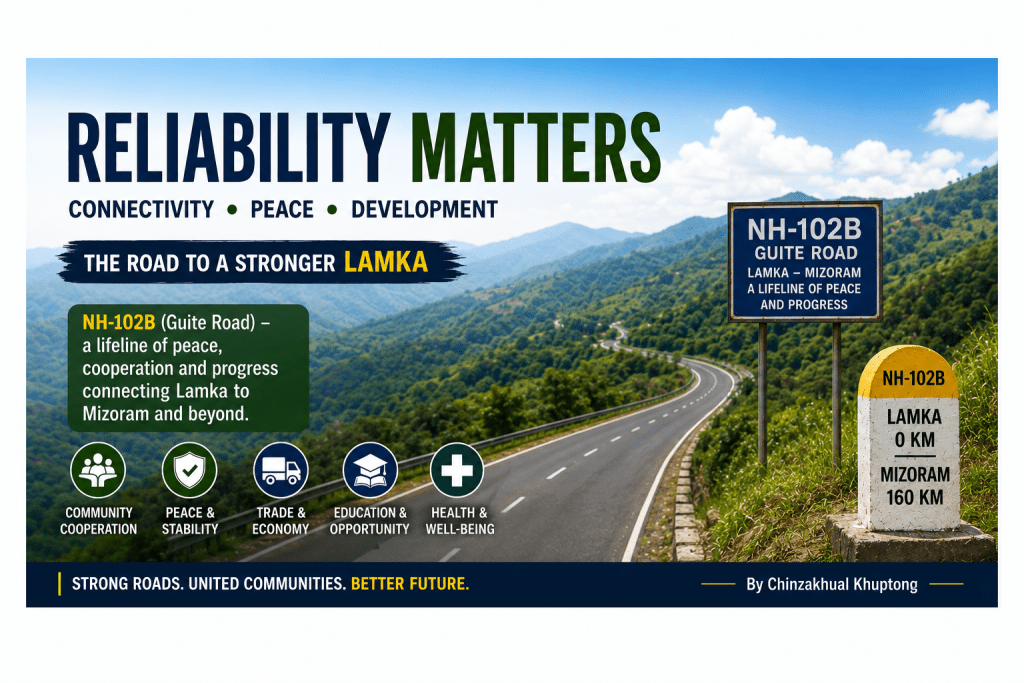
In contrast, NH-102B, commonly known as the Guite Road, has increasingly emerged as a critical alternative route for Lamka. Connecting Churachandpur to Mizoram and onward to the broader national highway network, this corridor has become especially valuable during periods when movement through NH-2 becomes difficult.
Admittedly, NH-102B is a longer route. Transporting goods through Mizoram generally requires more time, greater fuel consumption, and higher logistics costs. These additional expenses can contribute to increased prices of goods in local markets.
Yet despite its longer distance, NH-102B possesses an advantage that many travelers deeply appreciate: reliability.
Community Cooperation and Stability
One aspect of the Guite Road corridor that deserves recognition is the relative continuity of movement experienced by commuters over the years. While no highway is completely free from challenges such as landslides, heavy rainfall, or maintenance work, many travelers have observed that the route has generally remained accessible with fewer disruptions arising from human activities.
This achievement deserves appreciation. The communities living along the corridor, particularly in the Zomi-inhabited areas through which much of the route passes, have contributed to maintaining an environment where movement remains comparatively smooth and predictable. Such stability benefits not only local residents but also traders, students, patients, tourists, transport operators, and everyone who depends on the route.
The experience of NH-102B demonstrates that development is not achieved through infrastructure alone. Roads, bridges, and public facilities can only reach their full potential when communities collectively support peace, stability, and uninterrupted movement.
Looking ahead, strengthening both NH-2 and NH-102B should remain a priority. Lamka benefits most when multiple transport corridors remain safe, accessible, and functional throughout the year.
Reliable connectivity is more than a transportation issue. It is a foundation for economic growth, social harmony, and long-term development. The lessons offered by NH-102B remind us that peace and cooperation are essential ingredients of progress.


Leave a Reply