"A4A-BW" mission. Consider something like: Education, Business, Leadership, Technology and Society Study. My Old articles can be visited at : https://quals21.wordpress.com/
Understanding Banking, Insurance, and Mutual Funds in India
By Chinzakhual Khuptong (Steve)
A Simple Financial Awareness Guide for Everyone
Financial literacy is becoming increasingly important in modern life. Today, almost everyone uses banks, insurance services, or investment platforms in some form. However, many people still do not clearly understand how these systems work, how they differ, or who regulates them.
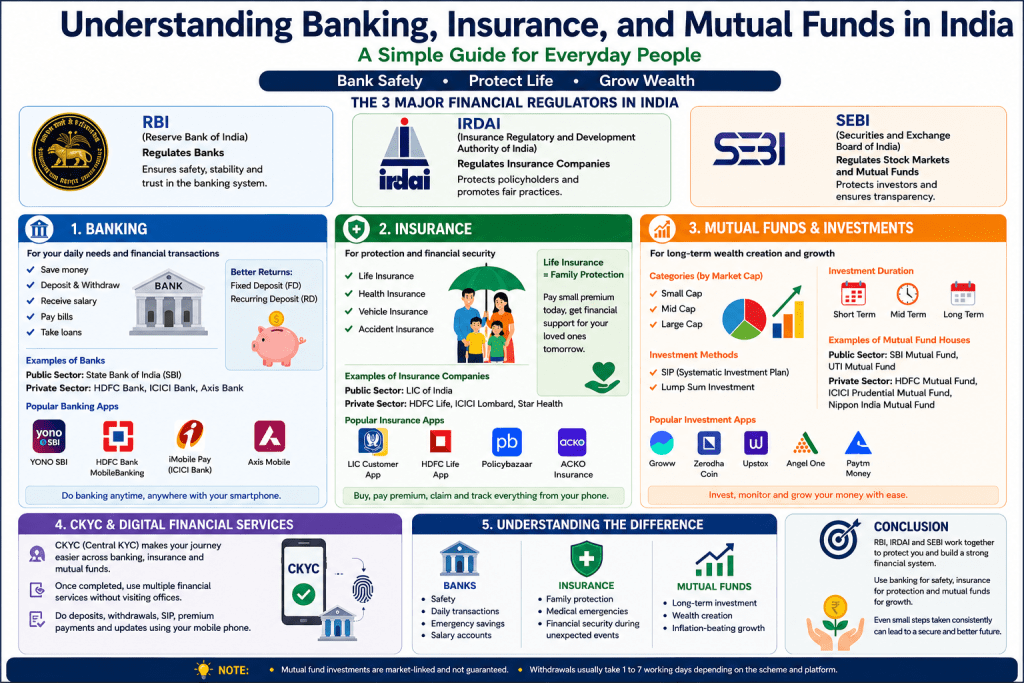
In India, three major regulators supervise the financial system:
RBI (Reserve Bank of India) → regulates banks
IRDAI (Insurance Regulatory and Development Authority of India) → regulates insurance companies
SEBI (Securities and Exchange Board of India) → regulates stock markets and mutual funds
These regulators help protect customers, maintain financial stability, and ensure transparency.
1. Banking and RBI
Banks are mainly used for:
Saving money
Depositing and withdrawing cash
Receiving salaries
Sending money
Paying bills
Taking loans
Banks are generally designed for safety and convenience rather than very high profit growth.
Savings account interest is usually low. However:
Fixed Deposit (FD)
Recurring Deposit (RD)
can provide slightly better returns compared to regular savings accounts.
Examples of Banks
Public Sector Bank
State Bank of India (SBI)
Private Sector Banks
HDFC Bank
ICICI Bank
Axis Bank
Popular Banking Apps
YONO SBI
HDFC Bank MobileBanking
iMobile Pay by ICICI Bank
Axis Mobile
Using these apps, people can transfer money, open deposits, pay bills, use UPI, check balances, and modify account details directly from smartphones.
RBI supervises banks and ensures the banking system remains safe and trustworthy.
2. Insurance and IRDAI
Insurance is mainly meant for financial protection, not primarily for profit generation.
The purpose of insurance is to reduce financial burden during emergencies, accidents, illness, or death.
Common Types of Insurance
Life Insurance
Health Insurance
Vehicle Insurance
Accident Insurance
Examples of Insurance Companies
Public Sector Insurance Company
LIC of India
Private Insurance Companies
HDFC Life
ICICI Lombard
Star Health Insurance
Popular Insurance Apps
LIC Customer App
HDFC Life App
Policybazaar
ACKO Insurance
Through these apps, people can buy insurance, pay premiums, download policy documents, file claims, and track insurance coverage.
In life insurance, people usually pay smaller premiums regularly for long-term financial protection.
The main purpose of life insurance is family protection. If the earning member dies unexpectedly, the insurance amount may help support parents, spouse, children, or dependents financially.
IRDAI ensures that insurance companies follow fair practices and protect customers properly.
3. Mutual Funds, Investments, and SEBI
Mutual funds are investment products designed mainly for long-term wealth creation.
Mutual funds collect money from many investors and invest in stocks, bonds, government securities, and other market assets.
These investments are regulated by SEBI.
Examples of Mutual Fund Companies
Public Sector Mutual Funds
SBI Mutual Fund
UTI Mutual Fund
Private Mutual Funds
HDFC Mutual Fund
ICICI Prudential Mutual Fund
Nippon India Mutual Fund
Categories of Mutual Funds
Small Cap
Mid Cap
Large Cap
Based on investment duration:
Short-term
Mid-term
Long-term
Investment Methods
SIP (Systematic Investment Plan)
Lump Sum Investment
Popular Investment Apps
Groww
Zerodha Coin
Upstox
Angel One
Paytm Money
Mutual fund investments are market-linked. This means returns can increase or decrease depending on market conditions and company performance.
Unlike savings accounts, mutual fund returns are not guaranteed.
Withdrawals from most mutual funds are generally processed within approximately 1–7 working days depending on the scheme type and platform.
4. CKYC and Mobile-Based Financial Services
Today, banking, insurance, and mutual fund sectors commonly use CKYC (Central KYC).
Once CKYC verification is properly completed, many financial services can be accessed digitally without repeatedly visiting offices.
People can now use smartphones for:
Deposits
Withdrawals
SIP investments
Insurance premium payments
Account modifications
Online KYC updates
This has made financial participation easier even for ordinary people with smaller incomes.
Earlier, many services required physically visiting offices repeatedly. Today, many services can be completed directly through mobile applications.
5. Understanding the Difference
Banks
Safety
Daily transactions
Emergency savings
Salary accounts
Insurance
Family protection
Medical emergencies
Financial security during unexpected events
Mutual Funds
Long-term investment
Wealth creation
Inflation-beating growth
Each financial product serves a different purpose and should not be confused with one another.
Conclusion
Financial awareness is essential in today’s world. Understanding the difference between banking, insurance, and investments helps people make safer and smarter financial decisions.
RBI, IRDAI, and SEBI play important roles in protecting customers and maintaining trust in India’s financial system.
Even small financial steps taken consistently can gradually build long-term financial stability and security.
Banking, Insurance leh Mutual Fund Tungtang Theihbehna
By Chinzakhual Khuptong (Steve)
Mimalte Ading Financial Awareness Guide
Tulai khovel ah sum leh pai tawh kisai theihna a poimawh mahmah hi. Tuni in mi tamtak in bank, insurance leh investment platform te zang vek uh ahihhang in, hiai teng bang chibang ahi ua leh, bang a,aki batlouh na , chih theichian nailou tamtak om hi.
India gam ah financial system a enkawl tu regulator lian pen thum om hi:
RBI → Bank te enkawl tu
IRDAI → Insurance company te enkawl tu
SEBI → Stock market leh mutual fund te enkawl tu
Hiai regulator te in customer humbitna, financial system bitna leh diktattak a thil hi ding in a nasepna uh na enkai tou den ua,a nasep na uh a dik lou om leh hiai enkai tute theih sak pah pah ding ahi.
1. Banking leh RBI
Bank ahih leh:
Sum koihna
Sum lakna
Salary lutna
Transfer bawlna
Bill piakna
Loan lakna
ding a zat pen ahi.
Bank chuh sum pung sakna ding sang in bitna leh awlsamna lam a ding in, a hoih zaw hi.
Savings account ah interest tawm hi. Himahleh FD (Fixed Deposit) leh RD (Recurring Deposit) te ah sum i koih leh a pung saving account sang in tam zaw deuh thei hi.
Bank khenkhat te
SBI
HDFC Bank
ICICI Bank
Axis Bank
Banking Apps khenkhat te
YONO SBI
HDFC MobileBanking
iMobile Pay
Axis Mobile
Hiai apps te ahihleh Play Store leh Apple App Store te ah download theih ahi.
Hiai apps zang in transfer, deposit, bill payment, UPI payment, balance check leh account modify hih theih hi.
RBI in bank te a enkawl a, banking system muanhuai leh bit ding in a enkol hi.
2. Insurance leh IRDAI
Insurance chuh sum pungsakna ding sang in sum humbitna ding hi zaw ahi.
Emergency, natna, accident leh sihna hun a sum lam buaina tawmna ding a hih ding ahi.
Insurance Chi tuam tuam te
Life Insurance
Health Insurance
Vehicle Insurance
Accident Insurance
Insurance Company te
LIC
HDFC Life
ICICI Lombard
Star Health
Insurance Apps zat theih te
LIC Customer App
HDFC Life App
Policybazaar
ACKO Insurance
Hiai apps te zang in insurance lakna, premium piakna, policy download, claim filing leh coverage te etna hih na in zat theih hi.
Life insurance ah premium tawmchik piak a,assured amount tam tak nei leh, hun sawttak sung cover neih te ahoih hi.
A ngim pen chu mi khat a sih khak leh a innkuan, a nu leh pa, a tate leh a sanggamten sum lam a buaina nei lou ding ahi. a insured mipa or minu a sih leh a nominee in sum tampi mu ding chih na ahi.
IRDAI in insurance company te a enkawl a customer te a humbit hi.Dan lou bang a thil hih om uh leh hai te kia report pah ding ahi
3. Mutual Fund leh Investment
Mutual fund ahihleh hun sawttak leh tawm chik sung hi thei, a dia , sum sukpungna ding a investment bawlna ahi.
Mutual fund ten mipi sum khawm ua stock, bond leh government security te bang ah invest uh hi.Mutual fund hih ten huai a , a sum pung pen share nei ban uh chihna ahi,huai te a kipei chihna ahi
SEBI in hiai investment system te a enkawl hi, huai ziak a buai na i neih leh complaint pah ding ahi.
Mutual Fund Company leh Mutual fund hih theihna te
SBI Mutual Fund
UTI Mutual Fund
HDFC Mutual Fund
ICICI Prudential Mutual Fund
Nippon India Mutual Fund
Mutual Fund Khen Dan
Small Cap
Mid Cap
Large Cap
Hun dungzui in:
Short-term
Mid-term
Long-term
Investment Dan
SIP → tawmchik tawmchik invest zelna,kikhol tou tou kha teng a Rs 100 rs 500 rs 1000 chih dan bang
Lump Sum → khatvei thu a alom a invest na
Investment Apps zat theih te
Groww
Zerodha Coin
Upstox
Angel One
Paytm Money
Hiai apps te chuh Play Store leh Apple App Store ah download theih ahi.
Hiai apps te SIP bawlna, mutual fund invest na, stock lei na, portfolio etna leh withdrawal bawlna in zat theih hi.
Mutual fund ahihleh market tawh kizop ahi ziak in a pung thei a, a kiam thei hi.
Market leh company performance dungzui in kikheng thei hi. Short-term ah a kiam thei a, hun sawt ah a pung tam deuh thei hi.
Savings account bang a guarantee return nei ahi kei hi.Ahih ziak in a pung hoih zaw tham tangpi mah mah hi.
Withdrawal chuh a tangpi in 1–7 working days sung vel la thei hi.Ut hun hun in redeem theih hi.
4. CKYC leh Mobile Phone Zatna
Tulai in banking, insurance leh mutual fund te in CKYC khat zangkhawm vek uh hi.
CKYC fel tak i neih leh office pha lou in mobile phone apan:
Deposit
Withdrawal
SIP
Insurance premium payment
Account modify
KYC update
te hih theih vek hi.
Tulai in mi sum tawmchik nei te nangawn in phone zang in financial system sung ah tel thei ta uh hi.smartphone tung tawn apan awlsam chik a, ahih theih tak ziak in
5. hai thil thum te ki batlouhna te
Bank
Sum bitna
Daily transaction
Emergency savings
Salary account
Insurance
Family sum lam ah humbitna
Medical emergency
Unexpected buaina hun ah
Mutual Fund
Hun sawt investment ah
Wealth creation ah
Inflation (Vanman Khang na) sang a “a pung tam zaw ding ahi”
Hiai financial product teng a ngim uh kibang lou ahi.
Thukhitna
Financial awareness chuh tulai khovel ah poimawh mahmah ahi. Banking, insurance leh investment te ki batlouh na, theih chuh sum leh pai tawh kisai, zekna leh etkol na ding in poimawh mah mah hi.
RBI, IRDAI leh SEBI te in India financial system muanhuai leh bit mah mah na ding in nasem uh hi.
Financial step tawmchik tawmchik lakna apanin le, hun sawt thu in financial lam ah bitna leh hamphatna hontun theih hi.





Leave a Reply