"A4A-BW" mission. Consider something like: Education, Business, Leadership, Technology and Society Study. My Old articles can be visited at : https://quals21.wordpress.com/
Tulai digital khovel ah mi tampi in online nasep leh work-from-home opportunity zong uhhi. Himahleh, lawmte’n hiai opportunityte zangin WhatsApp leh Telegram ah fake recruitment scam bawl uhhi.
Hiai scamte hi abul lam ah baihlam leh diktak bangin kilang hinapi, mi muan na ding in thil hih masa ua, atawp lam ah sum leh personal information lak sakna ding a thil hih uh ahi.
Koibang in Scam Kipan Hihiam?
WhatsApp ah random message muhna,
Telegram/WhatsApp group lian khat ah add hihna,
ahiloule “HR department” apan hiding mi khat in contact hon bawlna apan kipan hi.
Scammerte in:
part-time nasep,
in apan nasep,
flexible timing,
smartphone chauh zang ding “easy task” semding in mi zol uhhi.
Zolna Thupi
ni khat ah ₹1,000–₹3,000,
minute 10–15 chauh nasep,
Google ah 5-star rating pia,
YouTube video like pia,
social media page follow sak,
restaurant leh hotel review pia chihte in mizol uhhi.
Nasep neu khat hih dingin sum tampi kipe ding chih hih warning sign lian khat ahi.
Mimuan theih na ding bawlna
Scam diktak bangin kilatlouhna dingin scammerte in “demo task” khat pia masa uhhi.
₹100,
₹200,
ahiloule sum neu khat pe masa taktak in zol uhhi.
Hiai sum neukat hi psychological trap ahi. Mi lungsim ah “hiai hi diktaktak ahi” chi a ,a gintakna ding uh ahi.
Mi gintat zohchiang in scammerte in personal information leh sum tampi ,tam zaw sem laksak dingin pan la uhhi.
Hiai mun ah hi mi tampi in sum tampi mansuah uhhi.
Mi tampi in commission lian zaw sang ding kingaih tuah in voluntary in sum thot (deposit) uhhi, hinapi in scammerten a sum teng uh mangthang sak mai uhhi.
Thil Khat Chiangtak a theih ding
Phone number ahiloule UPI ID chauh sharing hileh sum gukmang pah theih ahi kei.
Himahleh,sum guk sak na dia hun leh thil poimawh lianpen chu:
payment request accept hia,
OTP sharing hia,
sum transfer hia,
suspicious app install hia hiai hun ah kipan hi.
Mi’n online ah mi theilo te kiang confidential banking information piak louh ding ahi.
Warning Signte
WhatsApp/Telegram ah random contact,
nasep neukhat dingin sum tampi,
kinawh lua a , hurry a thil bawlna,
deposit/recharge ngenna,
banking screenshot ngenna,
unknown trading platform join ding ngenna.
Thil khat a hoih lua lam leh dikta lua bang a ,akilat leh pilvang sem sem ding ahi.
Online job opportunity diktak om ngei hi. Himahleh, company diktakte in messaging app chauh zangin trivial task dingin sum tampi lohna nasep ape ngei kei.
Awareness, verification leh pilvangna hi digital scamte apan kiven na dia aphatuam pen ahi.
Live Screen Recording Demonstration
Awareness leh public education dingin Telegram-based cybercrime leh digital scam tungtang ka tuah khak ka live screen recording bawl ahi.
Hiai videote ah scammerte’n bangchi in mi zol uhhiam, fake task system bang chi a operate uh hiam, leh mi lungsim koibang in manipulate uhhiam chih chiang tak in kilak hi.
Hiai videote hi awareness, education leh cyber safety purpose ding chauh a share ahi.
By—-Chinzakhual Khuptong (Steve)
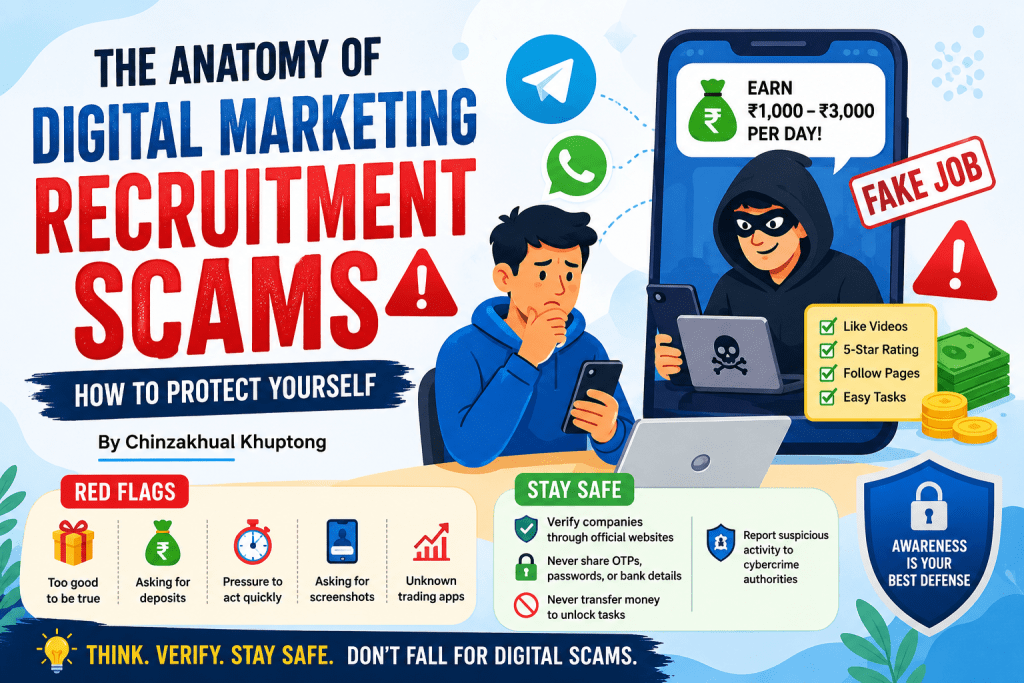
In today’s digital age, many people are searching for easy online jobs and work-from-home opportunities. Unfortunately, scammers are exploiting this demand by creating fake recruitment schemes through apps like WhatsApp and Telegram.
These scams often appear simple and harmless at first, but they are carefully designed to gain trust and eventually steal money or personal information.
How the Scam Usually Starts
These scams often begin when someone:
receives a random WhatsApp or Telegram message,
is added to a large group,
or is contacted by someone claiming to represent an “HR department” or a digital marketing company.
The scammers typically offer:
part-time work,
remote work-from-home jobs,
flexible working hours,
and “easy tasks” that only require a smartphone.
The Attractive Offer
To attract victims, scammers commonly promise:
₹1,000 to ₹3,000 per day,
only 10–15 minutes of work,
and very simple tasks such as:
giving 5-star Google ratings,
liking YouTube videos,
following social media pages,
or reviewing restaurants and hotels.
The payment offered is usually unrealistically high compared to the effort required. This is one of the clearest warning signs.
The Trust-Building Technique
To make the scheme appear legitimate, scammers often assign a small “demo task” first.
After completing the task, victims may actually receive:
₹100,
₹200,
or another small payment.
This small payment is a psychological tactic designed to build trust and create the impression that the job is genuine.
Once trust is established, the scammers gradually begin requesting more personal information and larger financial transactions.
How Victims Lose Money
After gaining trust, scammers may ask victims to:
share bank account details,
provide UPI IDs,
send screenshots of transactions,
or join a “trading” or “investment” platform.
At this stage, victims are often instructed to:
deposit money to unlock higher-paying tasks,
recharge accounts,
or invest money temporarily for larger returns.
This is usually where major financial losses occur.
Many victims voluntarily transfer money believing they will later receive larger commissions or profits, but the scammers eventually disappear.
Important Clarification
Simply sharing a phone number or UPI ID does not automatically allow scammers to steal money.
However, the risk increases significantly when victims:
approve payment requests,
share OTPs,
transfer money,
or install suspicious applications.
People should never share confidential banking information with unknown individuals online.
Major Warning Signs
Be cautious if a “job offer” includes:
unsolicited WhatsApp or Telegram messages,
extremely high pay for very simple tasks,
pressure to act quickly,
requests for deposits or “recharge” payments,
requests for screenshots of banking transactions,
or invitations to unknown trading or investment platforms.
If something sounds too good to be true, it probably is.
How to Stay Safe
To protect yourself:
verify companies through their official websites,
avoid unknown Telegram or WhatsApp job offers,
never share OTPs or banking passwords,
never transfer money to “unlock tasks,”
and report suspicious activity to cybercrime authorities.
Online job opportunities are real, but legitimate companies rarely recruit randomly through messaging apps for high-paying trivial tasks.
Awareness, verification, and caution remain the strongest defenses against digital scams.
Live Screen Recording Demonstration
For educational and public awareness purposes, I also recorded live screen demonstrations related to Telegram-based cybercrime and digital scam activities.
These videos show how scammers operate, how fake task systems work, and how people are psychologically manipulated through messaging platforms.
These recordings are shared strictly for awareness, education, and cyber safety purposes so that more people can identify and avoid similar scams.
By—-Chinzakhual Khuptong (Steve)
Tulai digital khovel ah mi tampi in online nasep leh work-from-home opportunity zong uhhi. Himahleh, lawmte’n hiai opportunityte zangin WhatsApp leh Telegram ah fake recruitment scam bawl uhhi.
Hiai scamte hi abul lam ah baihlam leh diktak bangin kilang hinapi, mi muan na ding in thil hih masa ua, atawp lam ah sum leh personal information lak sakna ding a thil hih uh ahi.
Koibang in Scam Kipan Hihiam?
WhatsApp ah random message muhna,
Telegram/WhatsApp group lian khat ah add hihna,
ahiloule “HR department” apan hiding mi khat in contact hon bawlna apan kipan hi.
Scammerte in:
part-time nasep,
in apan nasep,
flexible timing,
smartphone chauh zang ding “easy task” semding in mi zol uhhi.
Zolna Thupi
ni khat ah ₹1,000–₹3,000,
minute 10–15 chauh nasep,
Google ah 5-star rating pia,
YouTube video like pia,
social media page follow sak,
restaurant leh hotel review pia chihte in mizol uhhi.
Nasep neu khat hih dingin sum tampi kipe ding chih hih warning sign lian khat ahi.
Mimuan theih na ding bawlna
Scam diktak bangin kilatlouhna dingin scammerte in “demo task” khat pia masa uhhi.
₹100,
₹200,
ahiloule sum neu khat pe masa taktak in zol uhhi.
Hiai sum neukat hi psychological trap ahi. Mi lungsim ah “hiai hi diktaktak ahi” chi a ,a gintakna ding uh ahi.
Mi gintat zohchiang in scammerte in personal information leh sum tampi ,tam zaw sem laksak dingin pan la uhhi.
Hiai mun ah hi mi tampi in sum tampi mansuah uhhi.
Mi tampi in commission lian zaw sang ding kingaih tuah in voluntary in sum thot (deposit) uhhi, hinapi in scammerten a sum teng uh mangthang sak mai uhhi.
Thil Khat Chiangtak a theih ding
Phone number ahiloule UPI ID chauh sharing hileh sum gukmang pah theih ahi kei.
Himahleh,sum guk sak na dia hun leh thil poimawh lianpen chu:
payment request accept hia,
OTP sharing hia,
sum transfer hia,
suspicious app install hia hiai hun ah kipan hi.
Mi’n online ah mi theilo te kiang confidential banking information piak louh ding ahi.
Warning Signte
WhatsApp/Telegram ah random contact,
nasep neukhat dingin sum tampi,
kinawh lua a , hurry a thil bawlna,
deposit/recharge ngenna,
banking screenshot ngenna,
unknown trading platform join ding ngenna.
Thil khat a hoih lua lam leh dikta lua bang a ,akilat leh pilvang sem sem ding ahi.
Online job opportunity diktak om ngei hi. Himahleh, company diktakte in messaging app chauh zangin trivial task dingin sum tampi lohna nasep ape ngei kei.
Awareness, verification leh pilvangna hi digital scamte apan kiven na dia aphatuam pen ahi.
Live Screen Recording Demonstration
Awareness leh public education dingin Telegram-based cybercrime leh digital scam tungtang ka tuah khak ka live screen recording bawl ahi.
Hiai videote ah scammerte’n bangchi in mi zol uhhiam, fake task system bang chi a operate uh hiam, leh mi lungsim koibang in manipulate uhhiam chih chiang tak in kilak hi.




Leave a Reply