

Introduction
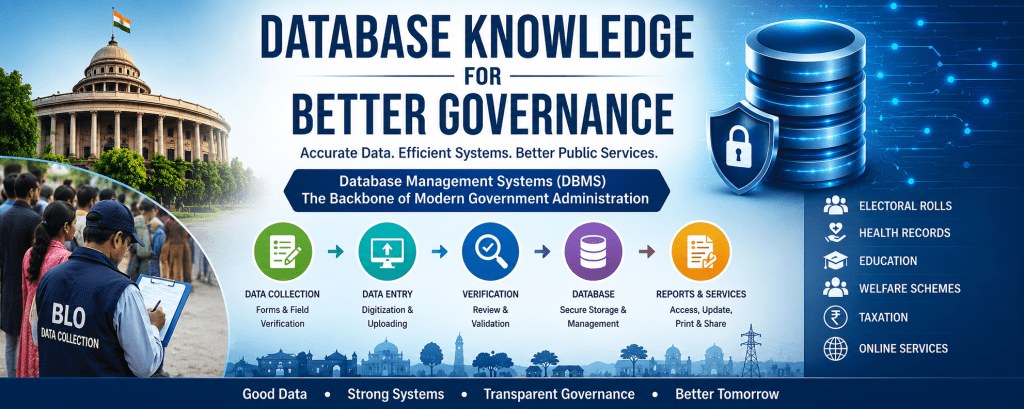
Many people associate government work mainly with civil servants, administrators, and field officers. However, in today’s digital age, another important area supports government services behind the scenes: Database Management Systems (DBMS).
Whether it is voter registration, health records, welfare schemes, taxation, education records, or online citizen services, almost every modern government system depends on data being collected, verified, stored, and managed properly.
This is where knowledge of databases becomes valuable.
What Is a Database?
In simple terms, a database is an organized collection of information stored electronically.
Think of it as a very large digital filing cabinet. Instead of searching through thousands of paper files, authorized officials can quickly find, update, verify, or print information whenever needed.
A database follows rules to ensure information remains accurate, consistent, and reliable.
Understanding Government Data Collection
When governments conduct surveys, voter verification exercises, or public service registrations, information is usually collected from citizens through forms or field verification.
The information is then entered into digital systems where it can be verified, processed, and managed more efficiently.
Using SIR 2026 as an Example
Using SIR 2026 as an example, Booth Level Officers (BLOs) collect information from citizens at the grassroots level.
The information is then entered into official systems and reviewed by authorized officials before being accepted into the official database.
Once stored, records can be searched, updated, corrected, verified, and printed whenever required.
This is database management in practice.
Why Are Paper Forms Still Used?
Paper forms continue to exist because they make it easier for citizens to provide information.
Most citizens do not interact directly with databases. Instead, they fill out forms designed to be easy to understand.
After verification and digitization, the information becomes part of a larger government database.
In many cases, physical records may also be retained for legal, audit, archival, or verification purposes.
Why Database Knowledge Matters
Database knowledge helps professionals understand:
- How information is stored
- How records are linked
- How errors are prevented
- How information is updated safely
- How large digital systems operate
This knowledge is useful not only for IT professionals but also for administrators, managers, researchers, and policymakers.
Can Database Professionals Help Educate the Public?
Yes.
Civil servants play the primary role in explaining government policies, procedures, and legal requirements to citizens.
At the same time, database professionals, software developers, and IT experts can help explain the technical side of digital systems.
Both administrative knowledge and technical knowledge are valuable and often complement one another.
Conclusion
Modern governance is increasingly driven by information and technology.
Behind every voter database, health portal, welfare platform, education system, and digital public service lies a structured system designed to collect, verify, store, and manage information efficiently.
Understanding databases does not replace knowledge of administration or public policy, but it provides an important perspective on how modern government systems function.
As governments continue their digital transformation journey, database knowledge will remain one of the key skills supporting efficient, transparent, and reliable public services.
— Chinzakhual Khuptong (Steve), MCA
Database Management System (DBMS)Government Service a, A Pawimawhna
Thumapi
Mi tampi in government nasep pen civil servant, administrator leh field officer te nasep chauh ah ngai sek uh. Himahleh, tu lai digital khawvel ah government service te nunglam ah, a na pang pawimawh dang khat om a, tua pen Database Management System (DBMS) ahi.
Voter registration, health record, welfare scheme, taxation, education record leh online government service te bang ah, le data dik taka lakkhawm, etfel, kholkhawm leh enkol a ngai.
Huai a dingin database theihna pen, a pawimawh mahmah hi.
Database Chih Bang Hiam?
A baihlam penin, database chih pen computer sung ah information leh record te a kimtak a kholkhawmna mun ahi.
Paper file sang tampi lakah record khat sui ding hita le awlsam lou hi,tua ziak mah in database zangten record te awlsam taka sui, bawlthak, etfel leh print thei uhhi.
Database sung ah rules leh constraints om a, tua te in data te dik leh kim takin a om sak thei hi.
Government Data Collection Dan
Government in survey, voter verification leh registration program te a neih chiangin, mipite kiang panin form leh field verification zangin data lakkhawm masa uhhi.
Huai data te pen computer system sung ah lut sak a, tua khit chiangin etfel leh verify masa uhhi.
Huai chiang chauh in official database sung ah lut thei hi.
SIR 2026 Etsakna
SIR 2026 program ah, Booth Level Officer (BLO) te in mipite kiang panin data lakkhawm uh.
Huai data te pen official system sung ah lut sak a, authority nei officer ten etfel na nei uhhi.
A dik leh kim a hih chiangin official database sung ah lut sak uhhi.
- Record sui thei
- bawlthak thei
- Diklou bawl dik thei
- Verify thei
- Report bawl thei
- Print thei hi
Huai teng pen Database Management System nasepna ahi.
Bang Hang a Paper Form Kizang Lai lai Hiam?
Paper form te pen mipite adingin a baihlam zaw hi.
Mi tampi in database thei vek lo uh ahih manin form te zangin data lakkhawm masa uhhi.
Huai khit chiangin data te verify a, database sung ah lut sak uhhi.
Khatvei vei audit, legal leh archival purpose ading in paper document te kem lai uhhi.
Bang Hang a Database Theihna Pawimawh Hiam?
- Data kholkhawm dan theisak hi
- Recordte kizopdan theisak hi
- Diklouhna om leh theisak hi
- Data update dan theisak hi
- Computer system lian te nasep dan theisak hi
Huai theihna pen IT mi chauh ading hilo in administrator, manager, researcher leh policy maker te ading ale pawimawh hi.
Thukhitna
Tu hun ah government nasep tamtak pen data tungtawn in a kizang ta hi.
Voter database, health portal, welfare scheme, education system leh online public service te nunglam ah database system om vek ta hi, a support tu in.
Database theihna in administration leh public policy maker te theihna a kheng khe kei a. Himahleh government digital system te bang chiin na a sem uh chih theihna ding in a pawimawh mahmah hi.
Government in digital transformation lam pibawl zel lai ahih manin, Database Management System theihna pen public service hoih zaw semna ding ah pawimawh semsem ding ahi.
— Chinzakhual Khuptong (Steve), MCA




Leave a Reply