

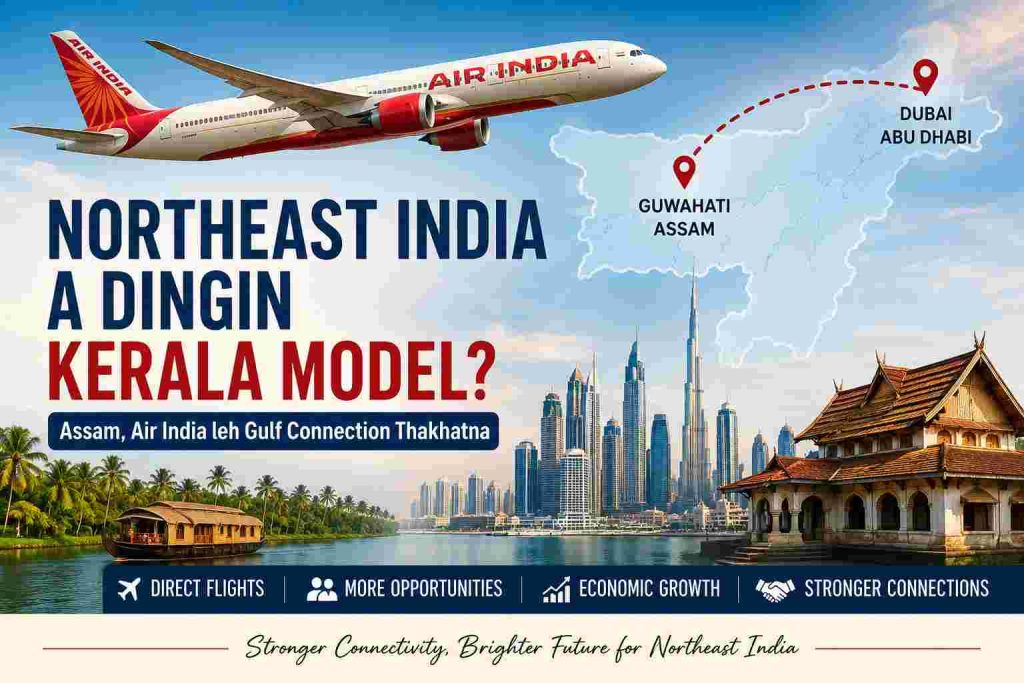
Northeast India’s Kerala Moment? A Thumbs Up to Assam, Air India and the New Gulf Connection
By Chinzakhual Khuptong (Steve)
Blogger on Northeast India and Global Affairs Since 2009
The announcement of direct flights from Guwahati to Dubai and Abu Dhabi marks a historic milestone not only for Assam but for the entire Northeast region. For the first time, Northeast India is moving closer to establishing direct links with some of the world’s most important economic hubs. The services are expected to begin in August 2026, strengthening the region’s international connectivity.
This achievement deserves appreciation for Air India, the Government of Assam, the Government of India, airport authorities, and all stakeholders involved.
Learning from Kerala
If policymakers are looking for a successful model, Kerala provides an important example.
Kerala’s four international airports—Cochin International Airport, Calicut International Airport, Trivandrum International Airport, and Kannur International Airport—maintain extensive connectivity with Gulf destinations.
Over several decades, strong air links between Kerala and the Gulf helped support a large overseas workforce. The resulting flow of remittances contributed to better housing, education, healthcare, entrepreneurship, and local economic development. Today, Gulf-bound and Gulf-returning passengers form a major share of international traffic in Kerala.
Kerala’s experience demonstrates an important lesson: air connectivity is not merely about transportation. It is about jobs, income, skills, investment, and opportunities.
Why This Matters for the Northeast
Northeast India has immense human potential but remains relatively under-connected to international destinations compared with many other regions of India.
Thousands of Northeasterners already work in Gulf countries in sectors such as healthcare, hospitality, aviation, retail, construction, engineering, and services. Direct connectivity can make travel easier, reduce transit time, lower travel costs, and strengthen links between families, businesses, and communities.
More importantly, people returning from advanced economies often bring back new skills, professional standards, business ideas, and global networks. This creates a positive “human cascading effect” where knowledge, experience, and opportunities gradually spread throughout society.
The Connectivity Gap
The contrast between Kerala and Northeast India is striking.
Kerala has enjoyed decades of strong international connectivity and has built a large global diaspora. Northeast India, despite its strategic location and population of more than 50 million people, is only beginning to establish direct international links.
This should not be viewed as a weakness but as an opportunity.
If Kerala’s connectivity helped transform its economy over time, then improved international connectivity could help unlock new possibilities for Assam and the wider Northeast region.
Looking Beyond the Gulf
The Gulf should be only the beginning.
Northeast India is geographically closer to Southeast Asia than much of mainland India. Future direct connections to Singapore, Bangkok, Kuala Lumpur, Ho Chi Minh City, and other Southeast Asian destinations could strengthen tourism, trade, education, investment, and cultural exchanges.
Such connectivity would align perfectly with India’s Act East Policy while positioning Guwahati as a gateway between India, Southeast Asia, and the Gulf.
A Call to Action
I hope the Central Government, Northeast state governments, airlines, airport authorities, and friendly Gulf nations continue investing in direct international routes from the region.
The Guwahati-Dubai and Guwahati-Abu Dhabi flights are more than new air services. They are bridges connecting Northeast India to global opportunities, wider markets, and a more prosperous future.
Kerala’s experience proves that sustained international connectivity can help transform lives and livelihoods. The Northeast deserves the same opportunity.
The region has waited a long time for such connectivity. This should be the beginning, not the end, of a larger vision for Northeast India.
Chinzakhual Khuptong (Steve)
Blogger on Northeast India and Global Affairs Since 2009
quals21.in

Leave a Reply